

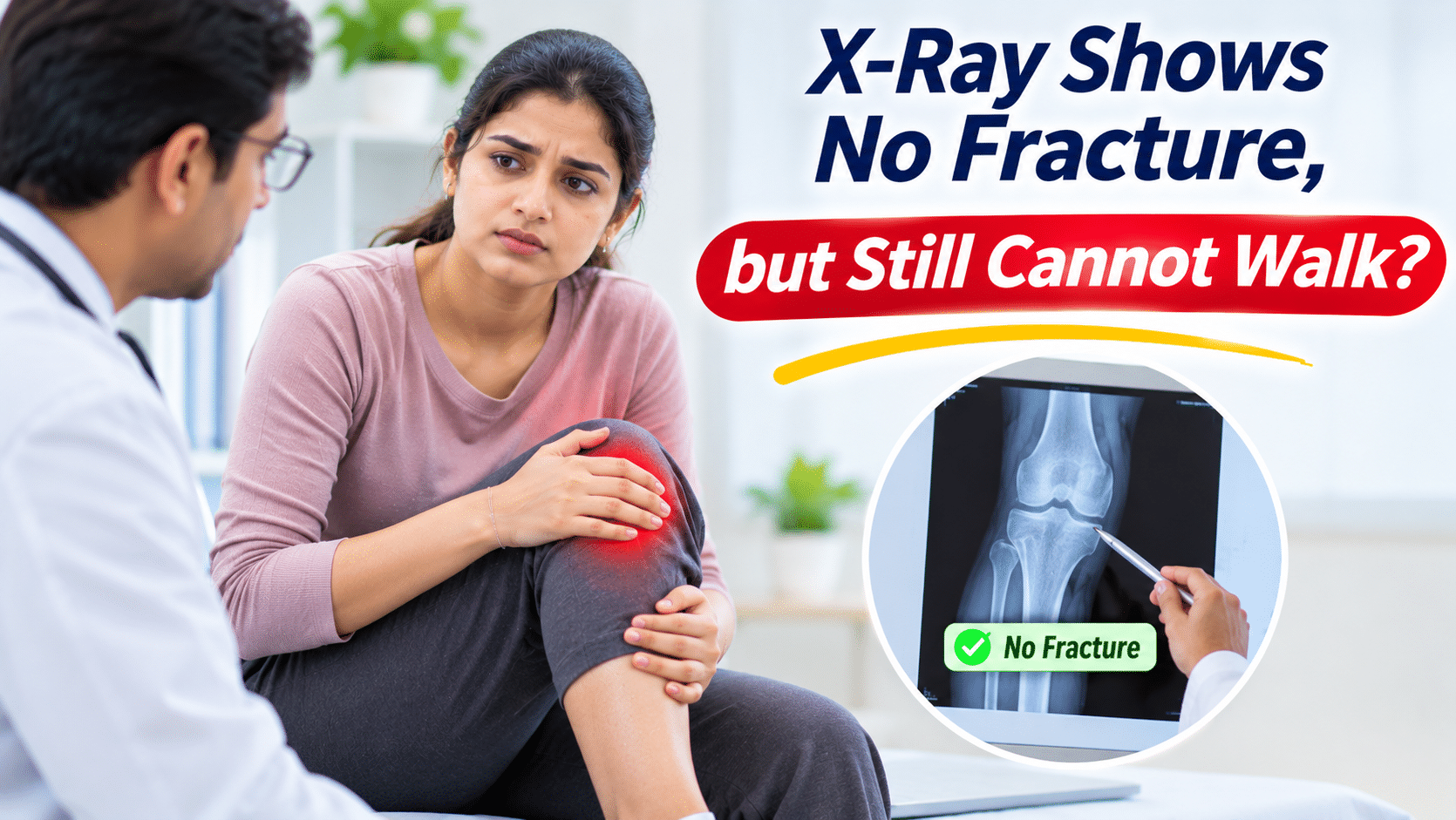
A normal X-ray does not always rule out a serious injury. Small fractures, ligament damage, tendon injuries or certain joint problems may not appear clearly on initial imaging. If you cannot put weight on your leg after an injury, seek prompt medical reassessment. An orthopedic doctor in Patiala can evaluate the cause and recommend appropriate investigations.
Why Does My Leg Still Hurt?
X-rays are useful for identifying many bone fractures, but they cannot reveal every injury affecting the leg.
Some fractures are difficult to detect immediately, particularly when the break is small or the bone remains aligned. Injuries involving ligaments, tendons and cartilage may also cause significant pain without appearing on ordinary X-rays.
Persistent leg pain after injury should therefore be assessed alongside swelling, tenderness, joint movement and the circumstances of the accident.
Being unable to stand or walk normally is an important finding, even when the initial report describes no visible fracture.
Can an X-Ray Miss a Fracture?
Yes. An occult fracture is a fracture that may not be visible on initial X-ray images.
Certain hip, ankle, foot and knee injuries can be difficult to identify during an early examination. The likelihood depends on the location, injury mechanism and imaging quality.
For example, a person who falls onto their hip may have significant pain despite an apparently normal X-ray.
When clinical suspicion remains high, further imaging may be necessary.
A normal report should never automatically override examination findings, particularly when someone cannot bear weight after an accident.
Could It Be a Ligament Injury?
Yes. Ligaments connect bones and help stabilize joints. Sudden twisting, awkward landing or excessive joint movement can stretch or tear these structures.
A significant ligament injury may cause swelling, pain, instability and difficulty walking.
How Is a Sprain Different?
A sprain involves ligament damage, ranging from mild stretching to complete tearing.
However, severe sprains and fractures can produce similar symptoms.
An orthopedic doctor in Patiala may examine joint stability and tenderness before deciding whether additional imaging is required.
Patients should avoid assuming that every injury described as a sprain is minor.
Can Tendons Cause Walking Problems?
Yes. Tendons connect muscles to bones and help produce movement.
A tendon injury may make it difficult to push off the ground, straighten a joint or support body weight.
Some injuries produce sudden pain or a popping sensation. Others develop through repetitive strain.
The symptoms depend on which tendon is affected and the severity of damage.
A soft tissue injury may require ultrasound, MRI or a focused clinical examination when ordinary X-rays do not explain the symptoms.
Not every tendon injury requires surgery, but significant functional weakness should receive timely evaluation.
Why Is My Knee Still Painful?
Knee pain after an accident can involve ligaments, cartilage, the kneecap or surrounding structures.
A twisting injury may damage the meniscus, which helps cushion the joint.
Symptoms can include swelling, catching, locking or difficulty bending and straightening the knee.
However, these findings do not establish a specific diagnosis.
Persistent leg pain after injury requires an examination to determine whether the problem involves bone, cartilage, ligaments or another structure.
A clinician may recommend further investigation if the knee remains unstable or movement is significantly restricted.
What If My Hip Hurts?
Hip pain after a fall deserves particular attention, especially in older adults.
Certain hip fractures may be difficult to identify on initial X-rays. Continuing pain and inability to bear weight can justify urgent additional imaging.
Where a hip fracture remains suspected despite negative X-rays, MRI is generally recommended when available promptly. CT may be considered when MRI is unavailable or unsuitable.
An occult fracture should not be dismissed simply because there is no obvious deformity.
Avoid forcing yourself to walk until a clinician has assessed whether weight-bearing is safe.
Do I Need Another Scan?
Not everyone with a normal X-ray needs additional imaging.
The decision depends on the examination, injury location, symptoms and likelihood of an injury that was not visible initially.
MRI can identify many hidden fractures and certain ligament, cartilage or tendon injuries.
CT provides detailed images of bone and may help investigate selected fractures.
Ultrasound can assist with evaluating certain tendon and other soft tissue problems.
An orthopedic doctor in Patiala can recommend the most suitable test rather than ordering every available scan.
What Should I Do Until Reassessment?
If you cannot bear weight after an injury, arrange prompt medical reassessment instead of repeatedly attempting to walk.
Avoid activities that increase pain. Use walking aids or immobilisation only as advised by a healthcare professional.
Cold packs wrapped in a towel may help reduce discomfort, while appropriate elevation can sometimes ease swelling.
Do not massage a severely injured area or attempt to force a painful joint into position.
Effective soft tissue injury care depends on identifying the affected structure and ensuring that a fracture or unstable joint injury has not been overlooked.
What Happens in a Real Situation?
Consider a hypothetical 62-year-old resident of Patiala who slips on wet flooring and develops hip pain.
An initial X-ray shows no obvious fracture. However, the patient still cannot stand comfortably or put weight on the affected leg.
During reassessment, the clinician reviews the fall, examines the hip and considers whether further imaging is necessary.
An MRI may be recommended if a hidden fracture remains suspected.
This example demonstrates why leg pain after injury cannot always be explained by the first imaging report.
It does not mean every painful hip contains a fracture.
When Should You Seek Urgent Help?
Seek urgent medical assessment if you cannot bear weight after an injury, particularly when pain is severe or worsening.
Emergency attention is important if the leg appears deformed, the foot becomes cold or numb, there is an open wound, or severe swelling develops.
These signs may indicate injuries requiring immediate treatment.
For patients exploring an orthopedic doctor in Patiala, the orthopaedics specialty page provides information about available musculoskeletal and trauma services.
Bring previous X-rays and reports to support reassessment.
Conclusion
A normal X-ray is reassuring in many situations, but it does not exclude every fracture or serious musculoskeletal injury.
Persistent inability to bear weight, significant swelling or worsening pain requires prompt reassessment.
An orthopedic doctor in Patiala can review the injury, examine the affected area and determine whether additional imaging is appropriate.
Early evaluation helps identify overlooked injuries, guide safe movement and reduce the risk of complications from continuing to walk on an unstable or damaged leg.
Frequently Asked Questions
1. Can a Fracture Be Missed on an X-Ray?
Yes. An occult fracture may not appear on initial images. Persistent inability to bear weight requires further clinical assessment.
2. Should I Walk If My X-Ray Is Normal?
Not necessarily. If walking is painful or impossible, avoid forcing weight onto the injured leg until medically assessed.
3. Can Ligament Damage Cause Severe Pain?
Yes. A significant soft tissue injury can cause swelling, instability and difficulty walking even without a visible fracture.
4. When Should I See an Orthopedic Specialist?
Consult an orthopedic doctor in Patiala promptly when pain, swelling or inability to bear weight continues after an injury.
5. Is MRI Always Necessary?
No. MRI is useful in selected cases, but the appropriate investigation depends on examination findings and suspected injury.
6. Can a Normal X-Ray Mean Nothing Is Wrong?
No. Persistent leg pain after injury may involve structures that ordinary X-rays cannot adequately assess.